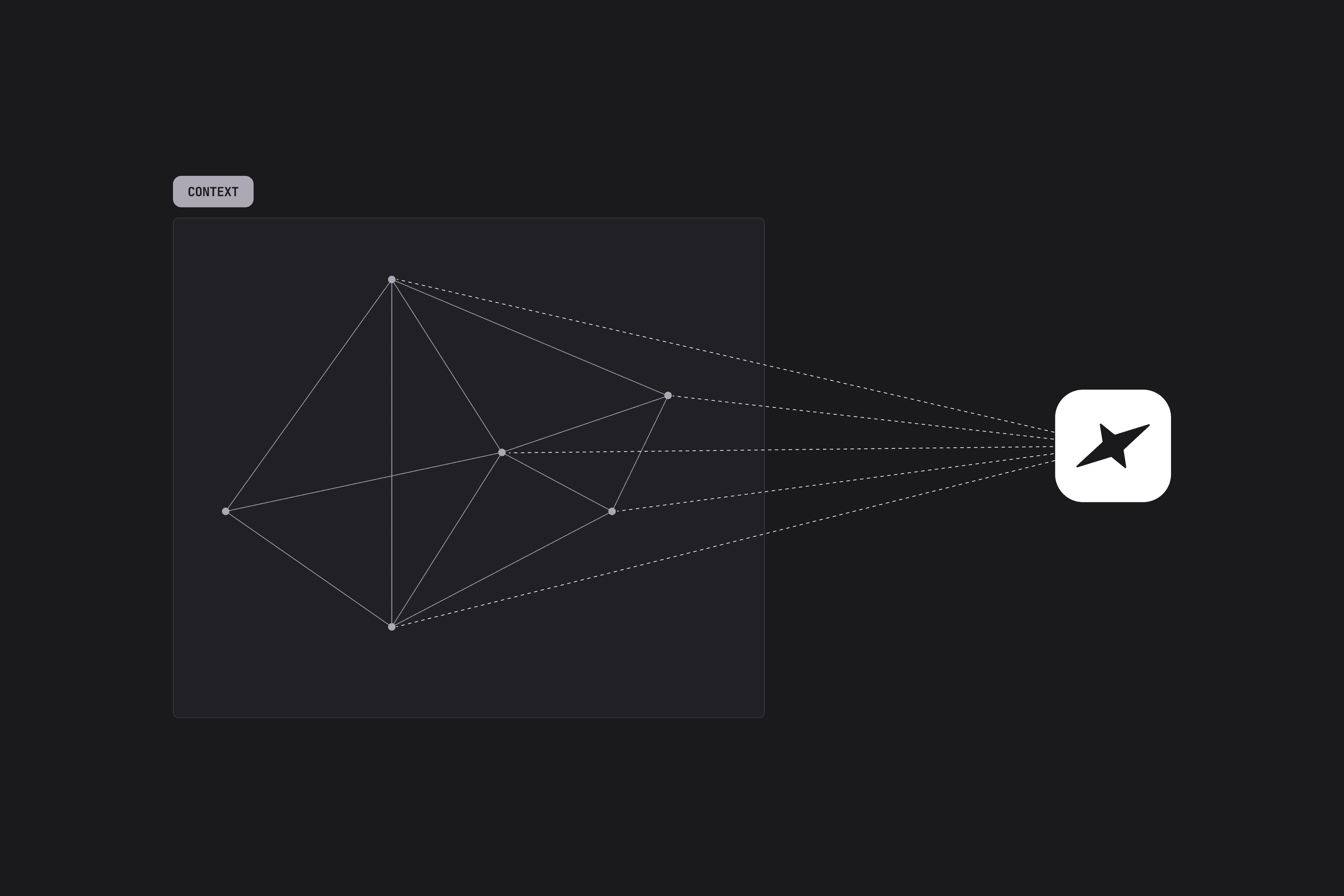
Summary: AI can be enormously helpful in strategy work. It only delivers truly valuable output, however, when it knows the full context of the strategy: positioning, personas, activities, touchpoints, KPIs and, above all, how they connect. A chatbot with a few uploaded documents only sees fragments of this. That is why its answers to strategic questions often stay generic. This article explains why that happens and what foundation AI needs for strategy work.
A Head of Marketing asks ChatGPT: "Why has the number of our qualified leads been dropping for the past three weeks?"
The answer arrives within seconds: ad fatigue, changed targeting, a weaker landing page, seasonal effects, tougher competition. Well structured, plausible and complete.
And yet it barely helps. Every point could be true, but none has been checked against the company's reality. Which campaign actually contributes to qualified leads? Which touchpoint dropped first? Which persona was it meant for? The model doesn't know. It can't know.
Many teams using AI in strategy work run into this pattern. According to a Bitkom survey from September 2026, 57 percent of companies in Germany with 20 or more employees use AI. Only 3 percent rate their own use as fairly advanced. The technology has arrived in everyday work. For strategic questions, though, the value often falls short of expectations.
This article explains why, why better prompts alone aren't enough, and what AI needs to genuinely help in strategy work.
What is the context problem of AI in strategy work?
The context problem describes the gap between what a language model knows about strategy in general and what it would need to know about a specific company's strategy to make a sound recommendation.
Language models like ChatGPT are trained on enormous amounts of knowledge. They know frameworks, best practices and the typical causes of typical problems. That is why their answers to strategic questions almost always sound reasonable.
What they lack is the business reality of the individual company: its positioning, its target groups, its ongoing activities, its current numbers and, above all, the connections between them.
Strategy researchers Christian Stadler and Martin Reeves reached a similar conclusion back in 2023 in experiments for MIT Sloan Management Review. According to their findings, ChatGPT helps generate more options but is less reliable when it comes to deciding which option is right for a particular company in a particular context.
That decision is exactly what strategy work is about.
Why better models and prompts alone aren't enough
The obvious conclusion would be that a better model or better prompts would solve the problem. Both fall short. Even the most powerful model can only work with what it sees. Better prompts shift the work to the people who write them. Three reasons make the context problem structural.
1. Strategy lives in connections
A strategy presentation contains statements: "We focus on mid-sized industrial companies." "Goal: 30 percent more qualified leads." "Q3 campaign on LinkedIn."
What is usually missing is the link between them. Which activity is meant to reach which persona? Through which touchpoint? Measured by which KPI? Which business goal does it ultimately contribute to?
Strategic statements only make sense within an impact chain. Uploading three documents to a chatbot gives it individual statements without this structure. The model has to guess the connections. Its guesses sound plausible, but nobody has verified them.
2. Strategic context goes stale every day
Even when a team prepares its context carefully, it remains a snapshot: last week's numbers, the persona from the spring workshop, the roadmap from before the last planning change.
Growth changes constantly. A touchpoint that worked in March can be the problem in June. A persona whose pain points have shifted keeps steering activities that no longer fit.
Context you copy and paste into a chat is outdated the moment you paste it.
3. Nobody asks the most important questions
The third reason carries the most weight. A chatbot answers questions. It waits for a prompt.
Yet the most expensive problems in strategy work are the ones nobody asks about: the touchpoint without a KPI, the activity without an assigned persona, the assumption nobody has checked in months. Blind spots are called that because you can't see them.
If you only ask about what you already suspect, AI gives you faster answers to familiar questions. The unknown ones stay unknown. In our Strategy Efficiency Score analyses, 9 out of 10 leadership teams overestimate their own strategic clarity.
What AI needs to be valuable for strategy
These three reasons lead to four requirements for AI to do more in strategy work than write text:
- Structured context: Positioning, personas, activities, touchpoints and KPIs are connected. Every relationship is explicitly captured.
- Up-to-date context: The context is continuously updated with execution and real numbers, instead of being pieced together again once a quarter.
- Continuous analysis: The AI regularly analyzes the full context and flags problems and potential, even when nobody asks the right question.
- Grounding in reality: Every insight is tied to a specific element, such as a particular touchpoint, persona or KPI. That keeps it clear what each insight is based on.
| AI with individual documents | AI with the full strategic context | |
|---|---|---|
| Knowledge base | General world knowledge plus uploaded files | Connected representation of positioning, personas, activities and KPIs |
| Timeliness | As of the last upload | Continuously updated |
| Mode of work | Responds to prompts | Also analyzes the context continuously |
| Output | Plausible, generic recommendations | Specific insights on specific elements |
| Blind spots | Stay invisible if nobody asks | Are made visible |
How cosmos™ uses AI in strategy work
cosmos™ is an AI-powered growth strategy platform for growth decision-makers at mid-sized companies. cosmos™ centralizes everything that belongs to strategy work: positioning, personas, activities, touchpoints and initiatives are connected along with their KPIs. This puts the context AI needs for strategy work in one place, in a clear structure.
On this foundation, cosmos™ uses AI in three ways:
Signals on problems and potential. The AI in cosmos™ continuously analyzes a company's entire cosmos and provides the problems and potential it finds as signals. For example:
- A touchpoint misses its target numbers two weeks in a row.
- Touchpoints are defined for the focus persona that are currently missing from your own execution.
- A KPI isn't delivering any data. Either there is an error in the integration, or there simply is no data. Both point to a blind spot.
- AI visibility tracking currently sits outside the impact chain, even though it is one of your key initiatives.
Suggestions for impact chains. Within cosmos™, the AI makes concrete suggestions for what impact chains could look like based on best practices. Whether and how the team adopts these suggestions is up to the team.
Connect your own AI tools. AI tools your team already uses, such as ChatGPT or Claude, can be connected to cosmos™. They then draw on the full context from cosmos™ for their answers.
cosmos™ is developed in Germany and hosted in the EU. Strategic data is not used to train third-party models.
Checklist: is your strategy ready for AI?
Before you ask a chatbot your next strategic question, take an honest look at the foundation. Five questions help:
- Is your positioning written down and still current? This means a reference that your activities actually align with day to day.
- Are your personas linked to specific touchpoints? Or do they exist as profiles with no connection to execution?
- Does every touchpoint have a KPI? Every touchpoint without a metric is a blind spot.
- Is it clear for every ongoing activity which goal it contributes to? Activities without a link to the business goal tie up budget without being steerable.
- When were your strategic assumptions last reviewed? If the answer is "at the last strategy workshop," you are probably working with outdated context.
If you answer no to more than two of these questions, work on your context first. With that foundation in place, any model will give better answers.
Conclusion: AI in strategy work needs the full context
AI in strategy work delivers valuable results when it knows the structure, the current numbers and the connections that a strategy actually consists of.
As long as AI only sees individual documents and waits for questions, it mainly helps with writing. With the full context, it can identify problems and potential, make suggestions and support teams in steering their strategy.
That applies to ChatGPT and other AI tools too: with access to the full strategic context, they answer the same question about dropping leads with a view of your touchpoints, your personas and your numbers.
The key question for growth teams is therefore: How much of our strategic context could an AI actually see today?
→ Why strategy work fails today – and how growth teams can move faster
If you want to see which problems and potential cosmos™ finds in your growth approach, talk to us. See a demo with your own data.
Sources:
- Bitkom Research, company survey on AI, September 2026 (603 companies with 20 or more employees)
- Stadler, C. & Reeves, M.: "Three Lessons From Chatting About Strategy With ChatGPT," MIT Sloan Management Review, May 2023
Frequently asked questions about AI in strategy work
ChatGPT can support strategy development, for example by gathering options, structuring ideas or drafting text. Without additional information, however, it lacks the company context needed for sound recommendations: positioning, target groups, ongoing activities, current numbers and how they connect.
The context problem describes the gap between a language model's general knowledge of strategy and the specific knowledge about a company that good strategic recommendations would require. Without this context, AI delivers plausible but generic answers.
A prompt can only carry a fragment of the strategic context. Strategy consists of relationships between goals, activities, personas and KPIs. It changes constantly and contains blind spots nobody asks about. None of this can be captured in a prompt for long.
For strategy work, AI needs a structured and up-to-date context: positioning, personas, activities, touchpoints and KPIs that are connected and continuously updated. Only then can it recognize connections and provide specific insights.
The AI in cosmos™ continuously analyzes a company's entire cosmos, including positioning, personas, activities, touchpoints and initiatives along with their KPIs. It provides the problems and potential it finds as signals. It also suggests what impact chains could look like based on best practices. AI tools such as ChatGPT or Claude that a team already uses can be connected to cosmos™ and then use the full context from cosmos™ for their answers.
Yes, if hosting and data processing are set up correctly. cosmos™ is developed in Germany and hosted in the EU, and strategic data is not used to train third-party models.
Keep reading
What alignment really costs: the hidden costs of misalignment
Creating strategic clarity takes up a huge share of leaders' time. And because it is only a snapshot, companies end up paying for it twice.
Read more
The 400-slide strategy has had its day: why strategy work is moving back in-house
80% of marketing decision-makers want to do more in-house. Why classic strategy work is the next thing moving back into the company.
Read more
Why strategy work fails today – and how growth teams can move faster
Why does strategy work fail? The 6 biggest problems, the 5 areas of strategic work and how they come together in one continuous system.
Read more